
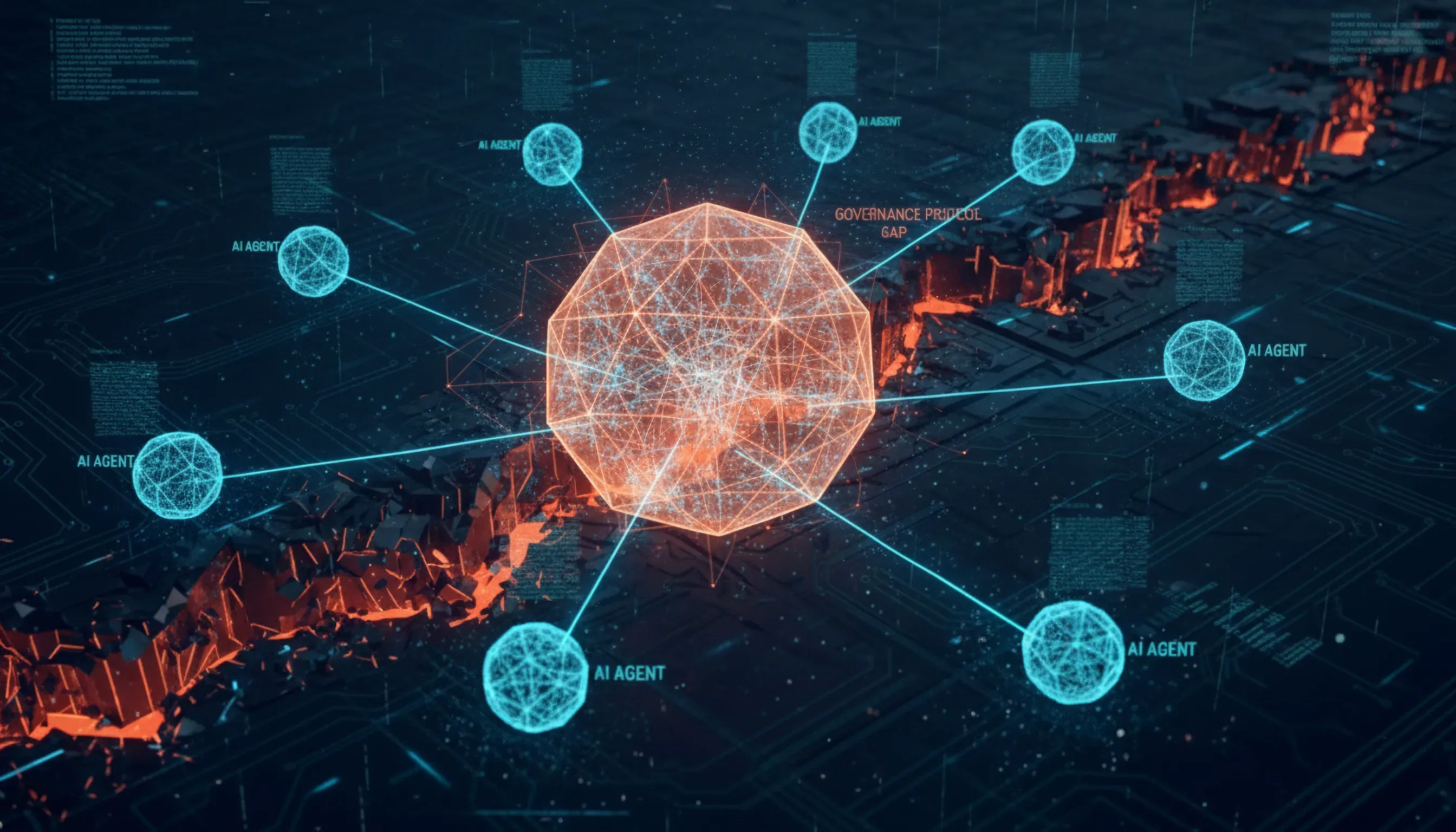
The Next Layer of BIM Maturity: AI, Agents, and the Governance Gap
Introduction Of AI Agents into the AEC Industry
A reflection on how BIM coordination will shift when AI agents begin participating in project decisions, and why AEC will need clear change governance protocols, not just smarter automation.
The Next Shift Is Not Accelerated Workflow
Most conversations about AI in BIM and AEC focus on faster resolutions: faster clash detection, faster quantity extraction, faster scheduling predictions. These improvements matter. They will save time and reduce repetitive work while improving visibility and uncertainty.
But they do not address the deeper shift. The real shift is not speed. It is the redistribution of decision-making inside coordination loops.
In a human-only workflow, a clash can be detected quickly, but its resolution relies on manual hand-offs. Someone analyzes it, evaluates the impact, and decides if the change is acceptable. Because logging the rationale is often inconsistent, this approval chain is slow, prone to contradictions, and heavily reliant on individual experience rather than standardized data.
It is also exactly where project control actually lives.
As AI agents evolve, they will move beyond simple detection, but increasingly propose changes, simulate probable consequences, and recommend actions across disciplines.
At that point, the question is no longer whether the industry has smarter tools. The question becomes, which agent is allowed to act on which consequence and under what governance framework?
Coordination Was Always a Governance Problem
In high-pressure project environments, the problem is rarely a lack of information. The problem is how decisions move, who is authorized to make them, and what happens when consequences cross discipline boundaries.
Even today, coordination failures often happen in a familiar sequence:
- A small design or procurement change enters late.
- One discipline resolves it locally.
- Downstream impacts cascade later.
- Cost or schedule absorbs the consequence.
- Nobody can clearly trace when the shift became significant.
The primary discourse generally revolves around the governance gap. BIM gave the industry a shared model. Coordination platforms improved visibility. Issue tracking improved communication.
But most teams still rely on human judgment to decide when a model change becomes a project change. That distinction is manageable when humans are the only active decision-makers, with concrete documentation sequences in place. It becomes unstable when multiple AI agents begin participating in the same loop.
What Changes in an Agent Assisted Environment
Consider a realistic coordination scenario:
- A supplier updates equipment dimensions for an AHU.
- A procurement-linked agent receives the revised data.
- A layout agent proposes a 400 mm shift to maintain clearance compliance.
- A routing agent adjusts nearby pipe paths. A cost agent flags added labor.
- A schedule agent identifies sequencing impact.
- A structural agent detects anchor realignment.
This can occur asynchronously in parallel, before a coordination meeting even starts.
From a technical perspective, this sounds efficient. From a project-control perspective, this introduces a new risk.
If multiple agents can propose and optimize changes in parallel, then local improvements can create cross-discipline consequences faster than a team can review them.
The danger is not that the agents are wrong. The danger is that they are each locally reasonable while the project outcome drifts globally.
AEC teams already struggle with this pattern in human form. AI agents will amplify it by exponentially increasing the frequency and speed of change proposals as they simultaneously improve their logic without BIM-centered guardrails, where each project necessitates different parameters and standards.
This is why the next layer of BIM maturity will not be only automation. It will change governance, since current AEC guardrails are designed for human speed.
From Detection to Decision Protocols
The industry does not only need better AI tools. It needs protocols that define how machine-proposed changes move through project authority. A useful way to frame this is through a simple concept:
ACIP is not another agent. It is a decision lifecycle that agents must pass through.
Agent Change Impact Protocol (ACIP)
ACIP is not another agent. It is a decision lifecycle that agents must pass through.
It defines:
- What counts as a significant change.
- What must be simulated before approval.
- Which roles must review which impacts.
- What can be auto-committed.
- What must be logged for accountability.
This matters because agents can assist evaluation, but they should not silently redefine responsibility.
A project still needs clear boundaries between Suggestion, Simulation, Recommendation, Approval, and Commitment.
Without those boundaries, coordination becomes a stream of machine-generated modifications with weak traceability. With them, AI becomes useful without eroding control.
A Practical Structure for ACIP v0.1
A basic protocol can be built from five parts.
1) Policy Layer
This is the non-negotiable layer.
Examples: Safety clearances, code requirements, cost ceilings, restricted zones, contractual constraints, and country-based ISO standards.
Function: Agents can reference policy. They cannot override it.
2) Process Layer
This defines the lifecycle of a proposed change.
A simple version: Draft → Simulate → Assess Impact → Route for Approval → Approve or Reject → Commit → Log Decision
Function: This ensures consistency even as project conditions shift.
3) Authority Map
This maps change categories to approval roles.
Examples: Spatial layout changes (MEP Lead), anchor or support changes (Structural Lead), cost impact above threshold (Project Controls), safety-adjacent zones (Safety Reviewer or Fire Consultant).
Function: The protocol remains the same across projects. Only the authority map changes.
4) Impact Synthesis
This is where agent outputs are consolidated into a single, structured summary:
- Affected disciplines
- Estimated cost and schedule impact
- Safety implications
- Confidence level and recommended action
Function: This reduces friction and keeps decisions intentional.
5) Decision Log
Every approved or rejected change should leave a trace. We record not just the outcome, but the rationale:
- What changed and who approved it?
- What impacts were accepted?
- Why was this option chosen?
- Which model revision did it enter?
This is less about paperwork, but increasingly about systemic memory.
For a project to evolve safely, its rationale must be as permanent as its structure.
The Most Important Part, Project Variability
No protocol should follow the same parameters across all projects. A hospital, a marine facility, and a high-rise tower do not carry the same risk profile.
Thresholds will change:
- Cost tolerance and schedule sensitivity
- Safety escalation criteria
- Auto-commit permissions and approval roles by phase
- ISO standards
A design-stage study may allow wider agent autonomy. An IFC-stage package may require tighter controls. A site coordination phase may need strict routing and logging for every spatial shift.
This is exactly why a protocol is useful.
It gives teams a stable structure while allowing project-specific parameters. In other words, the lifecycle stays consistent, while the limits and authority map adapt.
Why This Matters for BIM Teams Now
This is not a future problem. AI agents are evolving on a four-to-seven-month cycle. At this velocity, the future arrives before the next project phase begins.
The transition has already started in smaller forms: automated issue classification, model checking rules, design assistants, and schedule prediction tools. Each new capability adds another layer of machine influence to project decisions.
If the industry waits until agents are deeply embedded in production workflows, governance will arrive late and under pressure. AEC teams have an opportunity to define these rules early, while human authority is still clear and process design is still possible.
The goal is not to slow AI adoption, but to prevent unforeseeable decision drift.
Closing Reflection
BIM began as a geometry problem. Then it became an information problem. The next stage is a decision problem.
As AI agents begin participating in coordination, the industry will need more than intelligent tools. It will need clear rules for how intelligence enters project workflows, how impact is assessed, and how authority is preserved.
The future coordination challenge is not only detecting more clashes. It is governing more decisions. If that governance is weak, speed will magnify confusion. If that governance is clear, AI can become a real coordination partner.
That is a necessary shift worth preparing for.
The Great Delegation: A Final Hand-Off
The uncomfortable reality is that as AI agents sharpen their logic and project-specific guardrails become more precise, the need for human oversight will begin to fade. Eventually, we reach a point where the agents are so well-constrained by the protocol that they no longer require a human to sign off on every move. At that stage, the human element doesn’t just move faster, it moves out of the way.
This is the ultimate progress of our era: we are no longer just building structures or our perceived reality; we are building the intelligence that builds them.
© 2026 RJ, Nexus Engineering. All rights reserved.
****Field Notes and Journal Reflections on BIM, Coordination, and Systems Thinking.